

In 2025, MR4 took a decisive step forward.
With every release, the platform expanded beyond traditional biomechanics workflows—introducing capabilities that don’t exist in other systems and refining tools that users rely on every day. The result is a software environment built for real movement, long sessions, complex setups, and high-confidence analysis.
This recap pulls together the full scope of MR4’s 2025 advancements. Organized by product category, it highlights what’s new, what’s changed, and why these updates matter for anyone using MR4 to study, assess, or train human movement.
3D Motion Capture (IMUs)
IMU innovation was a major priority for MR4 in 2025. We didn’t just refine existing workflows, we introduced entirely new capabilities that change what’s possible with inertial motion capture. These tools address challenges other platforms ignore and deliver functionality you won’t find in competing systems.
Virtual Calibration Adjustment Tool (vCAT) — BETA
A visual, frame-based calibration correction workflow that allows users to refine avatar alignment when true neutral posture isn’t possible.

Intelligent Drift Stabilization for Motion
Real-time, auto-optimized drift correction across all body segments for more reliable motion data and dramatically faster processing.
Translation Toolbox for Linear Motion Analysis
Generate displacement, velocity, distance, and speed directly from IMU or model-based data using drift-aware calculation methods.
1–3 Sensor Mobility Assessments
Streamlined clinical and performance assessments using as few as one to three IMU sensors, supporting common mobility and gait workflows without complex setups.
Powers Running Assessment with Motion Sensors
Perform the full Powers Running Assessment using IMU-based kinematics without reliance on video capture.
IMU Acceleration Support for Biofeedback
Use raw IMU acceleration channels directly in biofeedback workflows for acceleration-based training and cueing.
Playback-Based Motion Streaming to Unity
Stream recorded motion data into Unity for advanced visualization, simulation, and digital twin applications.
Anatomical Data Streaming with MANUS Gloves
Integrate finger-level kinematic data from MANUS Gloves into MR4 for enhanced upper-limb visualization and analysis.
Force Plates
Horizontal Jump & Change of Direction Analysis
Automated analysis of horizontal jumps and cutting tasks using AP and ML shear-force metrics.
Optional Pre-Contact Phase for Jump & Cutting Analysis
Analyze neuromuscular and mechanical behavior in the milliseconds leading up to ground contact.
Unilateral Jump Test Side-by-Side Comparison
Compare left- and right-side jump performance within a single recording to assess asymmetry.
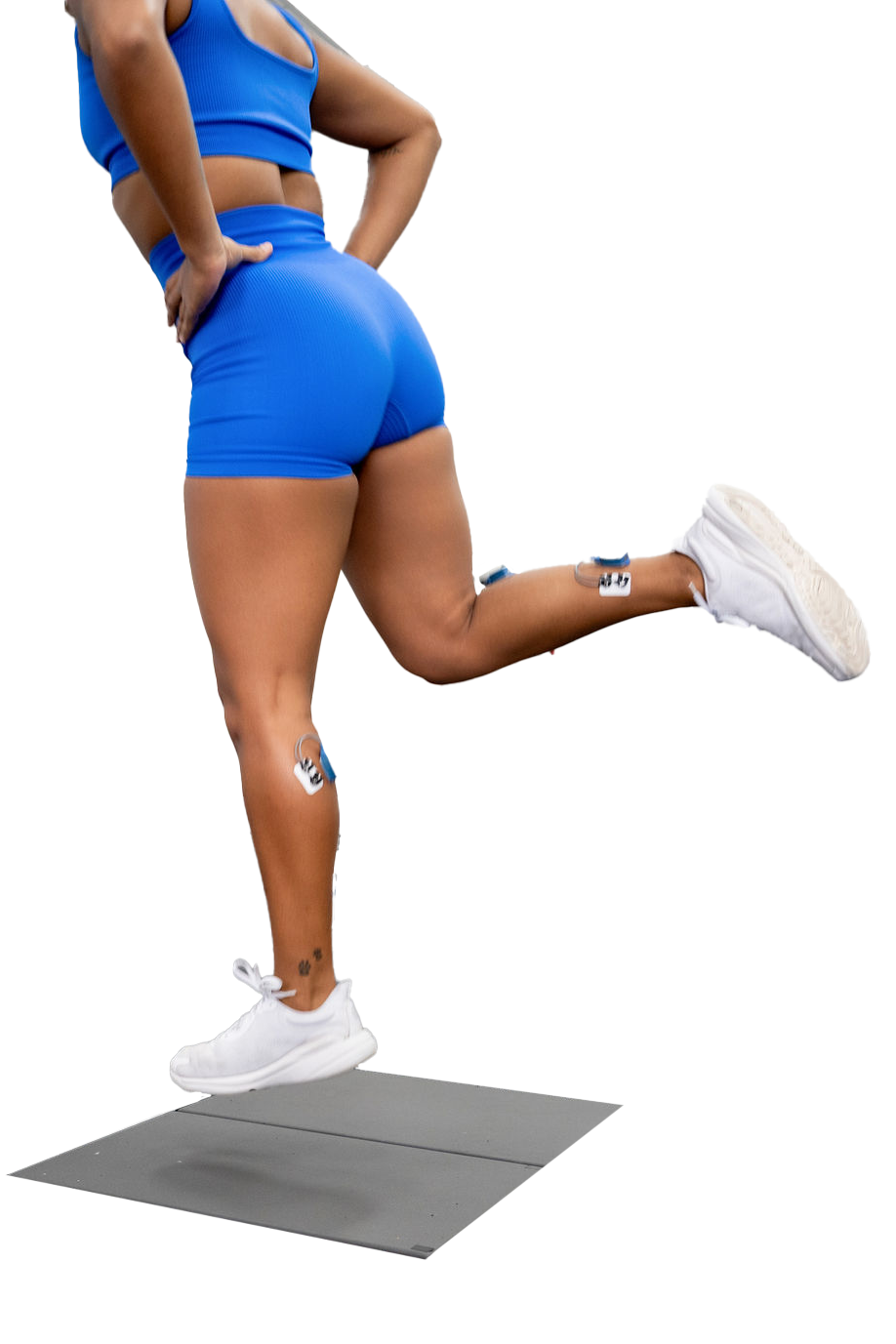
Video & Markerless Motion Capture
Floor Gait Analysis for 2D Markerless Tracking
Analyze floor-based gait patterns using 2D markerless video tracking without wearables.
Pressure-Instrumented Treadmills
Loading Rate Parameters with Selectable Units
Evaluate average and instantaneous loading rates using selectable units for injury risk and force profiling.
MR4 Platform, Reporting & Workflow Management
User-Defined Applications
Customize application labels and icons to align MR4 with specific workflows or programs.
Unified Import/Export for Applications, Protocols & Linked Reports
Simplify sharing of applications, protocols, and reporting templates across systems and teams.
Speedometer-Style Biofeedback Visualization
Provide intuitive, real-time visual feedback to guide training and rehabilitation.
Multi-Level Threshold Classification for Subperiods
Automatically classify data into customizable zones using multiple variable thresholds.
Data Maintenance Tool for Shared Databases
Manage shared databases by removing remote data directly from local MR4 installations.
Enhanced Filtering UI for Shared Databases
Quickly locate and manage data with improved filtering and navigation tools.