


Vertical Jump Analysis
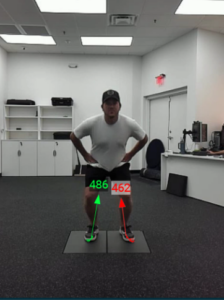
In this lab, students will use force plates to evaluate bilateral and unilateral countermovement jump performance.
Students will examine the vertical ground reaction force curve and key jump metrics to better understand jump strategy, performance, and interlimb asymmetries.
Why Analyze
Jump Performance?
Jump height tells you how high an athlete jumped; but it does not tell the full story of how they produced that jump.
By examining the force-time curve and metrics such as peak force, peak power, takeoff velocity, braking impulse, propulsive impulse, and countermovement depth, students can explore the different strategies athletes use to achieve similar outcomes.
This provides a more complete view of jump performance and can help students understand how force plate testing can be applied to athletic performance monitoring, return-to-sport decision making, and rehabilitation assessment.
Learning Objectives for Students
Evaluate Jump Performance Beyond Jump Height
Students will compare kinetic metrics across jump trials to understand why a single outcome such as jump height or peak force, may not fully represent performance or movement strategy.
Interpret the Force-Time Curve
Students will identify key phases of the countermovement jump, including quiet standing, unweighting, braking, propulsion, flight, and landing, and connect changes in vertical force to the athlete’s movement.
Compare Bilateral and Unilateral Performance
Students will compare right and left unilateral jumps with bilateral performance to investigate interlimb differences and movement strategies, including countermovement depth, trunk position, frontal-plane control, and landing strategy.
Connect Kinetics and Kinematics
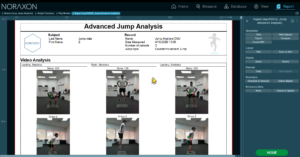
Using synchronized video or optional 2D markerless tracking, students can relate changes in the force curve to movements such as hip, knee, and ankle extension, countermovement depth, and landing mechanics.