

Automatic Jump Detection in MR
The myoFORCE module in MR streamlines jump assessment by automatically detecting specific jump types and extracting key performance metrics from force plate data. To ensure accurate event detection and meaningful interpretation of results, this document describes each supported jump type along with the proper execution criteria.

Vertical Jump Types
These jump assessments focus exclusively on the vertical ground reaction force (vGRF), and can often be performed either bilaterally or unilaterally, depending on the assessment goal.
Countermovement Jump (CMJ)
Defining Characteristics:
A countermovement jump is identified by a downward preparatory movement—a rapid eccentric dip—immediately followed by an upward, concentric extension that propels the athlete off the ground. This sequence engages the stretch-shortening cycle, making the movement both elastic and powerful.
Purpose & Application:
The CMJ is widely used across sport and performance settings because it reflects an athlete’s ability to store and release elastic energy, coordinate multiple joints, and rapidly transition from eccentric to concentric force production. Its relevance to real-world sport movements makes it a standard tool for assessing explosive lower-body performance.
Commonly Evaluated Metrics:
Typical CMJ analysis focuses on metrics that characterize eccentric loading, concentric force production, asymmetry (for rehabilitation) overall jump performance, including:
- Countermovement Depth
- Braking and propulsive durations
- Net impulse (loading and propulsive phases)
- Kinetic Asymmetry Index (eccentric and concentric)
- Peak Force
- Rate of Force Development
- Vertical stiffness
- Take-off Velocity
- Jump height by Net Impulse
- Reactive Strength Index
How to Perform a Countermovement Jump:
- Prior to the first jump, stand still on the force plate(s) for at least 1 second to capture body weight.
- With hands on hips, remain still prior to the initiation of each jump so movement onset is easily identifiable.
- Perform one or more jumps in a single measurement while taking off and landing with both legs as synchronously as possible.
- Be sure to pause for at least 1 second between the landing of one jump and the start of the next jump.
- After landing the last jump, stabilize and stand still on the force plate(s) for at least 1 second.
Key Points in Fz Signal:

- Stable baseline before unweighting phase
- Stable baseline right after landing
Note: Local peaks and noise strongly depend on mounting quality of plates.
Bilateral Countermovement Jump Analysis:
Bilateral analysis of the CMJ is available using the following default report templates, or any report using the Jump Analysis Report Class.
- Jump Analysis
- Jump Advanced Analysis
Note: For more information on report elements and customization of these reports, refer to the Report Elements section of this guide.
Unilateral Countermovement Jump Analysis:
Unilateral analysis of the CMJ is available using the following default report templates, or any report using the Unilateral Jump Analysis Report Class.
Note: For more information on report elements and customization of these reports, refer to the Report Elements section of this guide.
For Unilateral Jump Analysis, two force plates are required. Perform each jump as described above on one leg only on the correctly-sided force plate. Multiple jumps can be performed, and they are automatically detected according to the side they are performed on.
Squat Jump (SJ)
Definiting Characteristics:
A squat jump begins from a static, held squat position—typically around 90° of knee flexion—and requires the athlete to initiate the jump without any downward movement beforehand. Because no eccentric dip occurs, the jump isolates the pure concentric action of the lower limbs.
Purpose & Application:
The SJ is used to assess an athlete’s concentric force-production capability without contributions from the stretch-shortening cycle. This makes it useful for separating elastic utilization from true concentric strength, evaluating explosive starting strength, and comparing performance against CMJ results to understand efficiency in elastic energy use.
Commonly Evaluated Metrics:
Typical SJ analysis focuses on concentric-only performance characteristics such as:
- Propulsive duration
- Propulsive Impulse
- Peak Propulsive Force
- Average Propulsive Force
- Rate of Force Development (RFD)
- Take-Off Velocity
- Jump Height by Net Impulse
- Reactive Strength Index (RSI)
How to Perform a Squat Jump:
- Prior to the first jump, stand still on the force plate(s) for at least 1 second to capture body weight. ‘
- With hands on hips, bend knees to ~90 deg and hold the position.
- Perform one or more jumps in a single measurement by taking off directly from the bent knee position, i.e., concentric phase only — DO NOT UNWEIGHT!
- Take off and land with both legs as synchronously as possible.
- After stabilizing, return to the bent knee position and hold for at least 1 second before starting the next jump.
- After landing the last jump, stabilize and stand still on the force plate(s) for at least 1 second.
Key Points in Fz Signal:
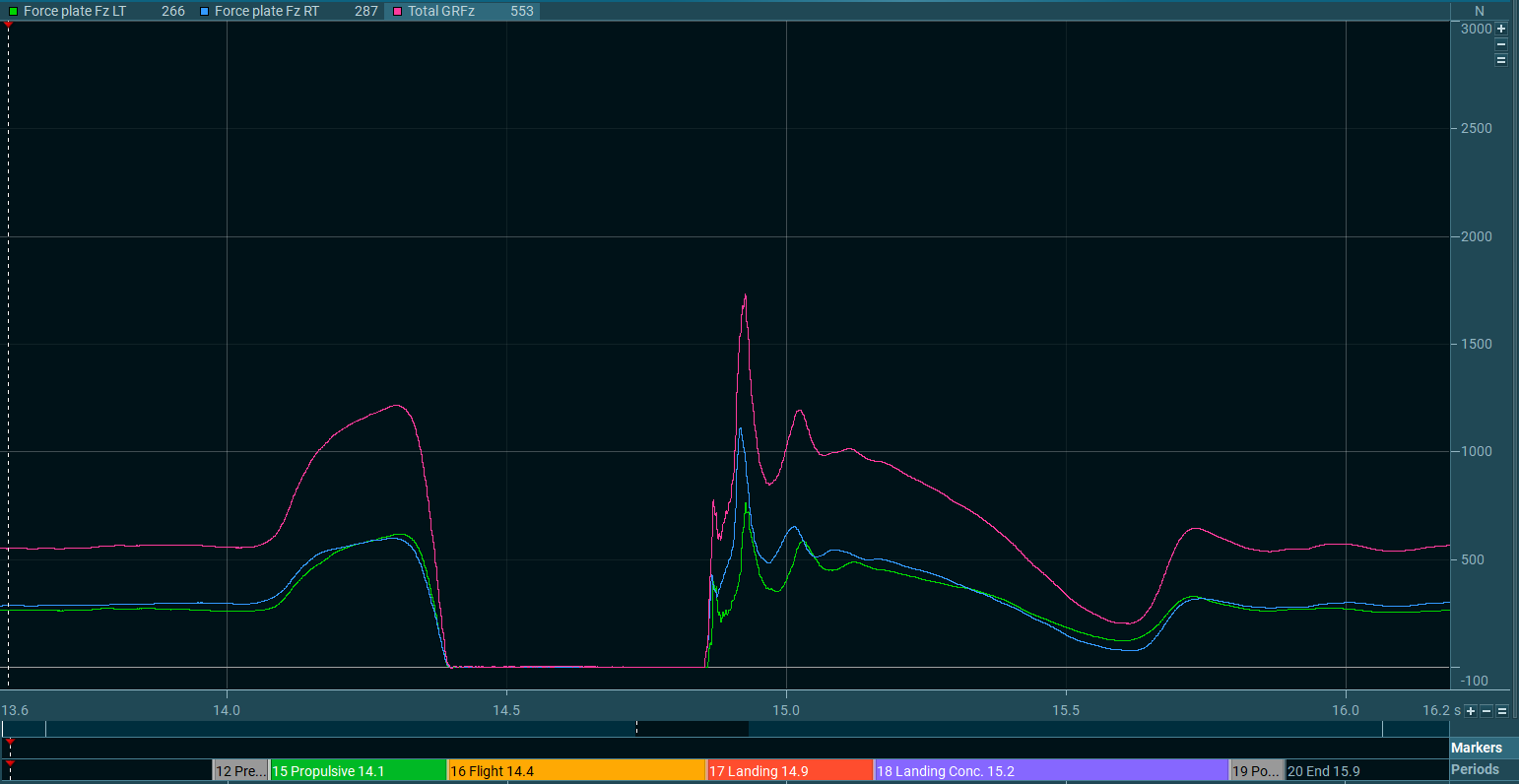
- Stable baseline before propulsive phase
- No unweighting prior to propulsive phase
- Stable baseline right after landing
Note: Local peaks and noise strongly depend on mounting quality of plates.
Bilateral Squat Jump Analysis:
Bilateral analysis of the SJ is available using the following default report templates, or any report using the Jump Analysis Report Class.
- Jump Analysis
- Jump Advanced Analysis
Note: For more information on report elements and customization of these reports, refer to the Report Elements section of this guide.
Drop Jump (DJ)
Defining Characteristics:
A drop jump consists of the athlete stepping off a box of a pre-determined height (e.g. 30 cm), landing on a force plate, and then rapidly rebounding into a vertical jump with minimal ground contact time. The sequence involves a short, forceful eccentric phase immediately followed by an explosive concentric phase.
Purpose & Application:
The DJ evaluates the athlete’s reactive strength and ability to rapidly absorb and reapply force—key qualities for sprinting, change of direction, and plyometric performance. Because the DJ includes pre-activation elements and short ground-contact demands, it is often used in performance testing, neuromuscular diagnostics, and return-to-sport monitoring.
Commonly Evaluated Metrics:
DJ analysis typically emphasizes reactive and eccentric-concentric transition qualities, including:
- Braking Duration
- Braking Impulse
- Propulsive Duration
- Propulsive Impulse
- Peak Loading Force
- Peak Landing Force
- Rate of Force Development (RFD)
- Vertical Stiffness
- Take-Off Velocity
- Jump Height by Net Impulse
- Reactive Strength Index
How to Perform a Drop Jump:
- With hands on hips, step — DO NOT JUMP — off a raised platform onto the force plate(s).
- Land and take off from the force plate(s) with both legs as synchronously as possible.
- After the second landing, stabilize and stand still on the force plate(s) for at least 1 second.
- Step off the force plate(s), return to the raised platform, and repeat drop jump protocol as needed.
- After the last jump, stand still on the force plate(s) for at least 1 second.
Key Points in Fz Signal:
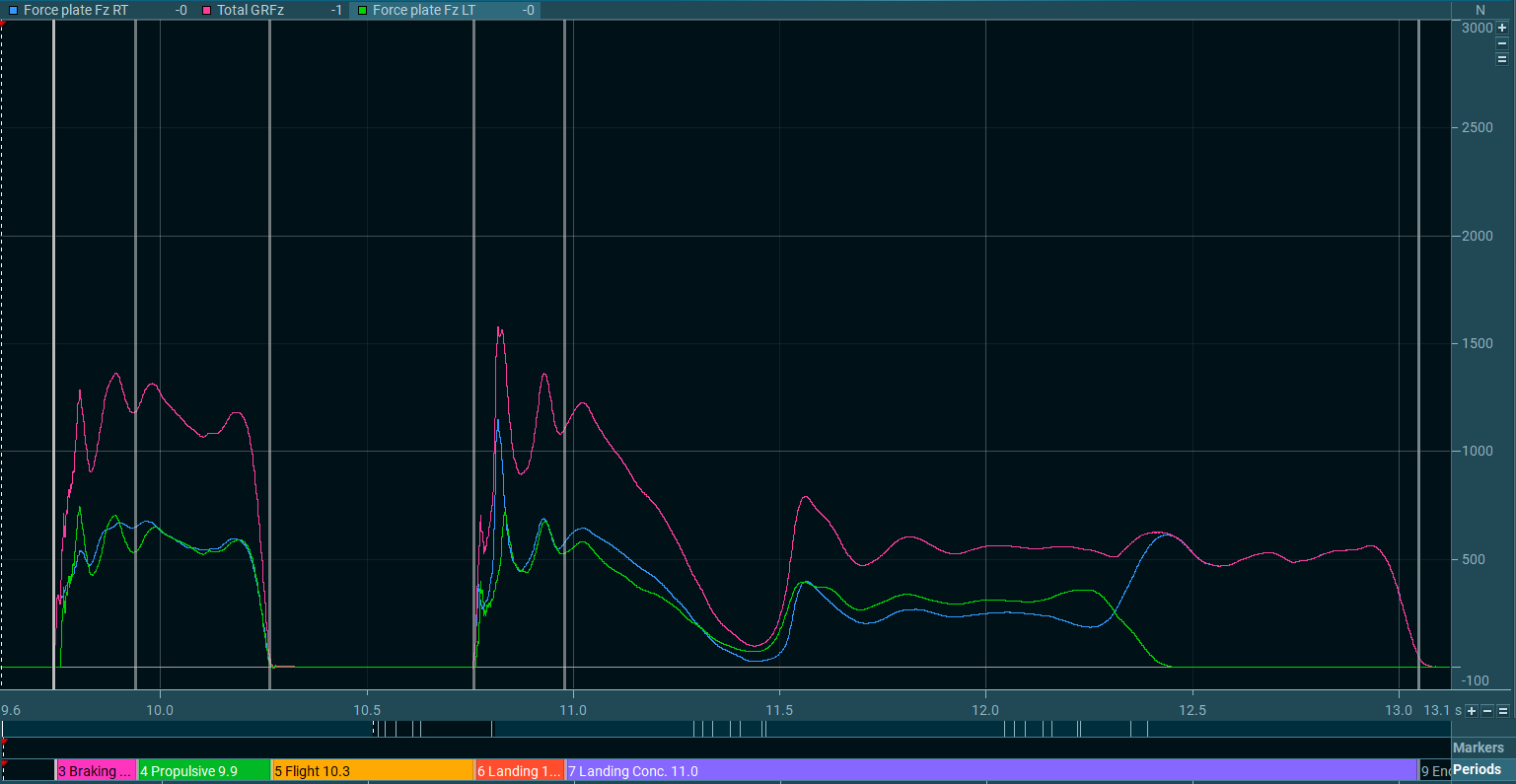
- Stable baseline right after landing
Note: Local peaks and noise strongly depend on mounting quality of plates.
Bilateral Drop Jump Analysis
Bilateral analysis of the DJ is available using the following default report templates, or any report using the Jump Analysis Report Class.
- Jump Analysis
- Jump Advanced Analysis
Note: For more information on report elements and customization of these reports, refer to the Report Elements section of this guide.
Unilateral Drop Jump Analysis:
Unilateral analysis of the DJ is available using the following default report templates, or any report using the Unilateral Jump Analysis Report Class.
- Unilateral Jump Comparison
Note: For more infomration on report elements and customization of these reports, refer to the Report Elements section of this guide.
For Unilateral Jump Analysis, two force plates are required. Perform each jump as described above on one leg only on the correctly-sided force plate. Multiple jumps can be performed, and they are automatically detected according to the side they are performed on.
Jump Landing (JL)
Defining Characteristics:
In the jump landing assessment, the athlete performs a forward horizontal jump from a designated starting point or a jump from a height above the force plate, and lands on the force plate. Only the landing phase is captured, focusing on how the athlete absorbs horizontal and vertical forces upon contact.
Purpose & Application:
This assessment is designed to quantify horizontal jump landing mechanics, including shock absorption, stability, and force-attenuation strategies. It is commonly used to evaluate lower-limb robustness, readiness for field-sport demands, and asymmetries in landing performance.
Commonly Evaluated Metrics:
Since only the landing is recorded, BJ landing analysis focuses on:
- Peak Landing force
- Landing Net Impulse
- Landing Kinetic Asymmetry Index (eccentric and concentric phases)
- Time to Stabilization (TTS)
- Rate of Force Development (Landing)
How to Perform a Jump Landing:
- With hands on hips, jump forward onto force plate(s) from a specified distance away either from in back of the force plate or from a step.
- After landing, stabilize and stand still on the force plate(s) for at least 1 second.
- Step off the force plate(s), return to the starting position, and repeat broad jump protocol as needed.
- After the last jump, stand still on the force plate(s) for at least 1 second.
Key Points in Fz Signal:
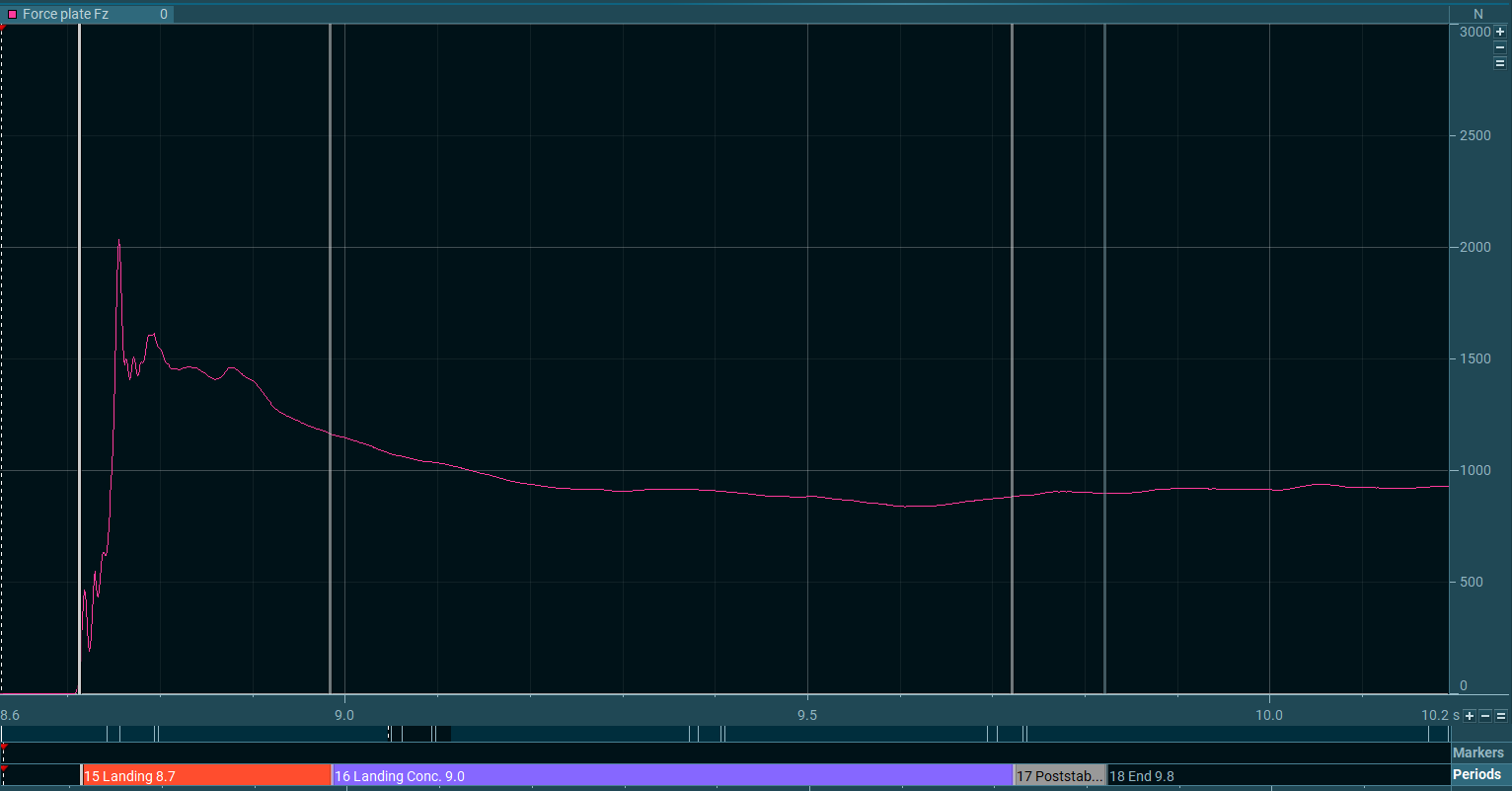
- Stable baseline right after landing
Note: Local peaks and noise strongly depend on mounting quality of plates.
Bilateral Jump Landing Analysis:
Bilateral analysis of the jump landing is available using the following default report templates, or any report using the Jump Analysis Report Class.
- Jump Analysis
- Jump Advanced Analysis
Note: For more information on report elements and customization of these reports, refer to the Report Elements section of this guide.
Unilateral Jump Landing Analysis:
Unilateral analysis of the jump landing is available using the following default report templates, or any report using the Unilateral Jump Analyssis Report Class.
- Unilateral Jump Comparison
Note: For more information on report elements and customization of these reports, refer to the Report Elements section of this guide.
For Unilateral Jump Analysis, two force plates are required. Perform each jump as described above on one leg only on the correctly-sided force plate. Multiple jumps can be performed, and they are automatically detected according to the side they are performed on.
Hopping
Defining Characteristics:
A hopping task consists of repeated, rhythmic single-leg or bilateral ground contacts with minimal flight time between contacts. Each hop involves a rapid sequence of landing, force absorption, and immediate re-propulsion, producing a highly cyclical vertical ground reaction force profile. The defining feature is the repeated stretch-shortening cycle performed with short contact times and limited joint excursion.
Purpose & Application:
Hopping assessments are used to evaluate an athlete’s reactive strength, elastic energy utilization, and neuromuscular endurance across multiple consecutive contacts. Because hopping requires repeated force absorption and re-application on the same limb, it is particularly valuable for:
- Lower-limb stiffness and tendon function assessment
- Single-leg load tolerance evaluation
- Return-to-sport testing following ankle, Achilles, or knee injury
- Monitoring fatigue effects on reactive performance
- Assessing inter-limb differences in cyclic force production
Hopping tasks are commonly used in both performance and clinical settings to bridge the gap between isolated jumps and more complex plyometric or running demands.
Commonly Evaluated Metrics:
Temporal Metrics
- Contact time
- Flight time
Force & Impulse Metrics
- Peak Force (loading/landing)
- Average Force (loading/landing)
- Net Impulse
- Rate of Force Development (RFD)
Reactive & Performance Metrics
- Reactive Strength Index (RSImod)
- Vertical Stiffness
- Jump Height (derived from flight time or impulse)
Consistency & Asymmetry Metrics (in bar or line graph format)
- Step-to-step variability in force or contact time
- Left–right asymmetry (for unilateral hopping)
- Fatigue-related changes across consecutive hops
How to Perform Hopping
- Prior to the first jump, stand still on the force plate(s) for at least 1 second to capture body weight.
- Place hands on hips and assume an upright posture.
- Begin hopping by performing quick, rhythmic contacts with the ground, minimizing ground contact time between hops.
- Land and immediately take off with no deliberate pause between contacts, emphasizing a rapid transition from landing to propulsion.
- Maintain a consistent hopping rhythm and height throughout the measurement.
- Perform multiple consecutive hops within a single recording, ensuring each hop is executed in a similar manner.
- If performing unilateral hopping, remain on the same leg for the entire trial.
- After completing the final hop, stabilize and stand still on the force plate(s) for at least 1 second to allow clear detection of the end of the trial.
Key Points in Fz Signal:
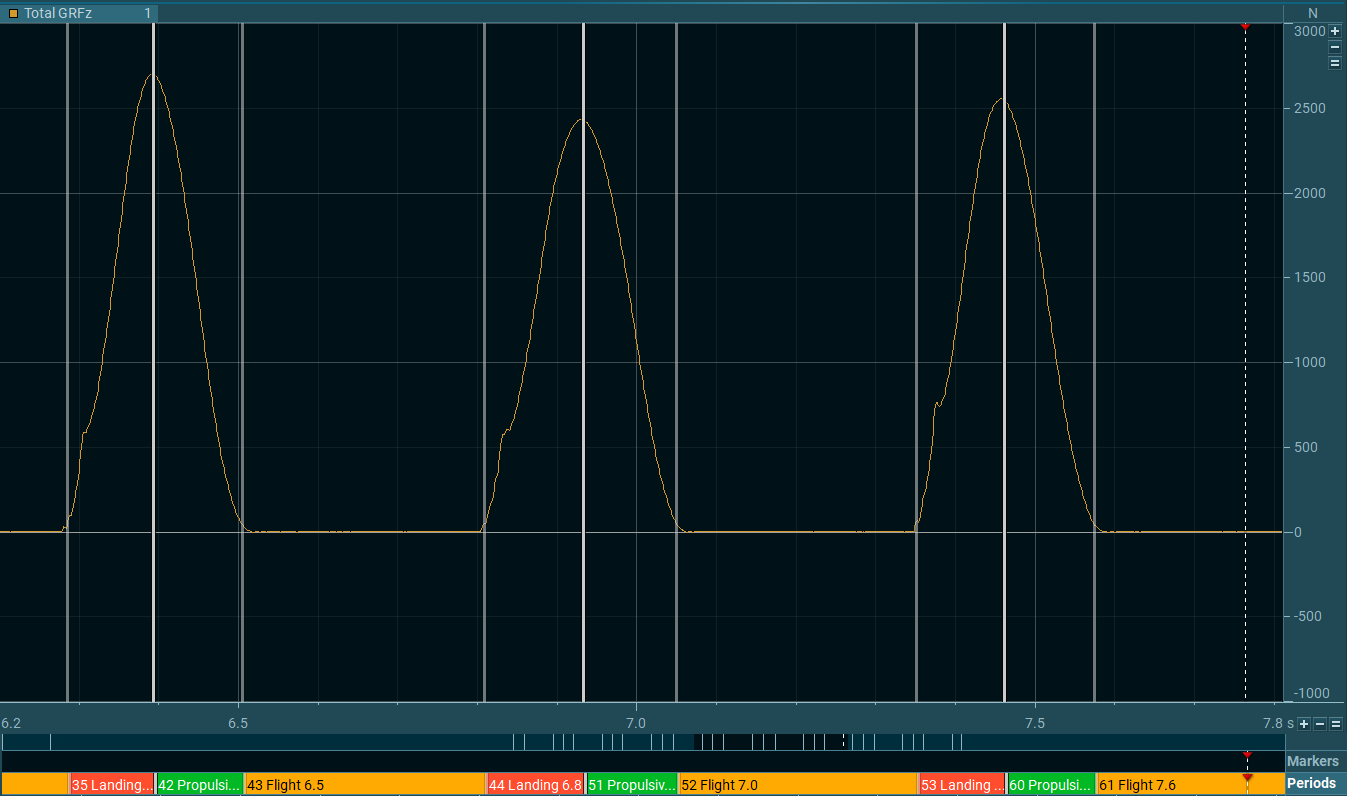
- Continuous jumps with smooth landing and propulsive phase
Bilateral Hopping Analysis
Bilateral analysis of the hopping is available using the following default report templates, or any report using the Jump Analysis Report Class.
- Jump Analysis
- Jump Advanced Analysis
Note: For more information on report elements and customization of these reports, refer to the Report Elements section of this guide.
Unilateral Hopping Analysis
Unilateral analysis of hopping is available using the following default report templates, or any report using the Unilateral Jump Analysis Report Class.
- Unilateral Jump Comparison
Note: For more information on report elements and customization of these reports, refer to the Report Elements section of this guide.
For Unilateral Jump Analysis, two force plates are required. Perform each jump as described above on one leg only on the correctly-sided force plate. Multiple jumps can be performed, and they are automatically detected according to the side they are performed on.
Horizontal Jump Types
Horizontal jump and cutting tasks—broad jumps, lateral jumps, 505 cuts, accelerations, decelerations — play a central role in sport performance and return-to-play decision-making. A 3D force plate is required for detection of horizontal jump tasks so that the horizontal force curves can be analyzed.
Broad Jump (BJ)
Defining Characteristics:
The forward broad jump performed from a force plate with the landing occurring off the plate is a horizontal explosive movement that captures only the loading and propulsion phases of the jump. The athlete begins in a bilateral stance on the force plate and performs a rapid countermovement followed by forward propulsion, leaving the plate at toe-off and landing beyond the measurement area. This setup allows for detailed analysis of the unweighting, eccentric braking, and concentric propulsion phases, but excludes landing mechanics. Unlike vertical jumps, this movement requires a coordinated combination of vertical and anterior-posterior force production, with a specific emphasis on generating horizontal impulse to project the center of mass forward.
Purpose & Application:
This jump variation is particularly valuable for assessing horizontal force production capabilities, which are critical for activities such as sprint acceleration, change of direction, and performance in many field and court sports. By isolating the take-off phase, the test provides insight into how effectively an athlete can orient force in the horizontal direction, which is often a distinguishing factor between athletes with similar vertical jump performance but differing sprint abilities.
From a neuromuscular perspective, this movement helps evaluate coordination strategies, including the balance between hip- and knee-dominant contributions, as well as the efficiency of transitioning from braking to propulsion. In rehabilitation settings, the absence of a landing phase reduces impact demands, making this a useful early-stage assessment to monitor recovery of explosive intent and force production capacity.
Commonly Evaluated Metrics:
Since only the landing is recorded, BJ landing analysis focuses on:
- Peak Force
- Rate of Force Development (RFD)
- Braking Force (AP & ML)
- Propulsive Force (AP & ML)
- Peak Power
- Braking Impulse (AP & ML)
- Propulsive Impulse (AP & ML)
How to Perform a Broad Jump:
- Stand still for 1 second on the force plates before beginining any jumps to detect a stable body weight interval.
- With hands on hips, jump forward off of force plate(s).
- Return to the starting position, stabilize, and repeat broad jump protocol as programmed.
Key Points in Fz Signal:
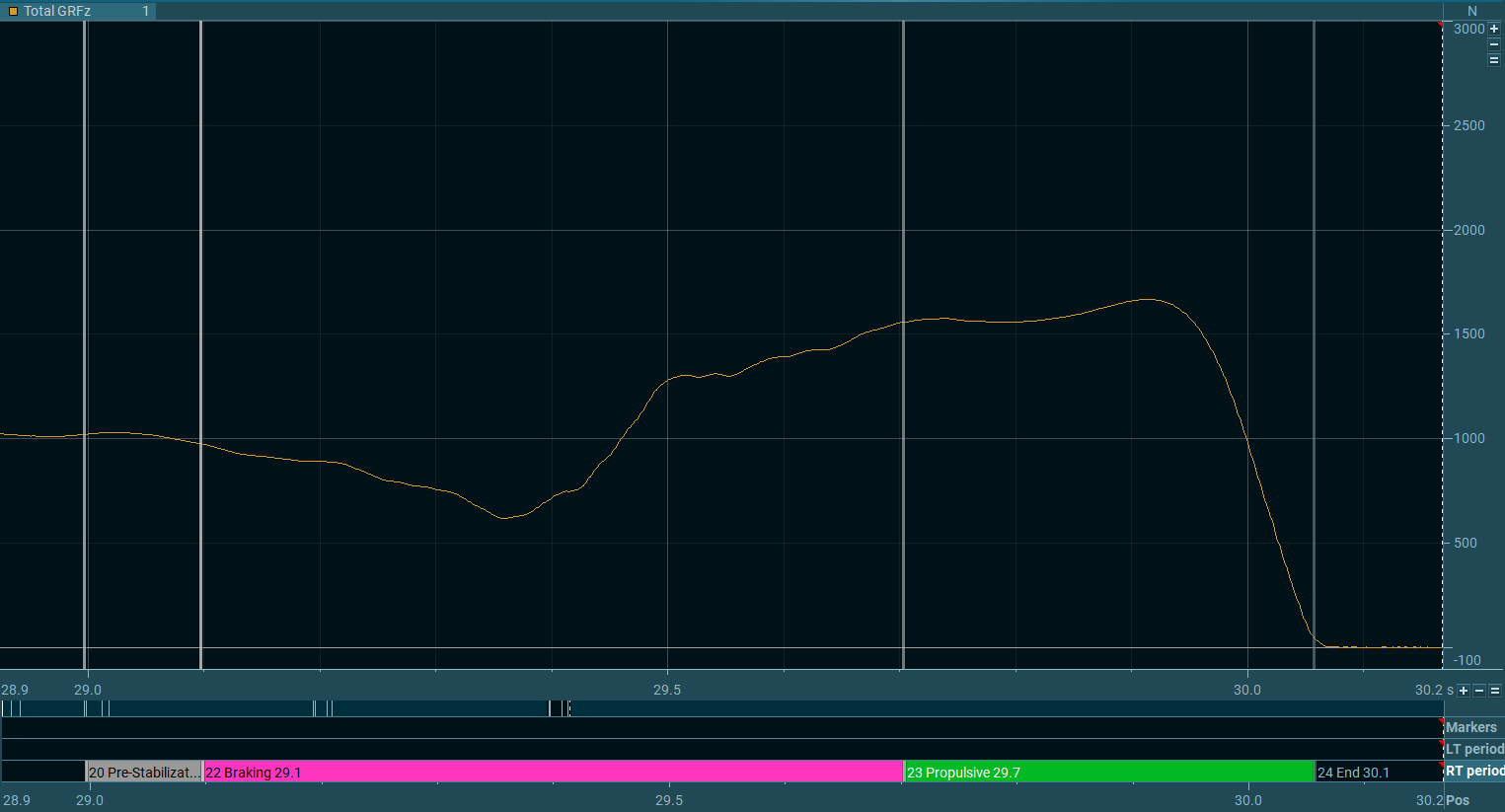
- Stable baseline right after landing
Note: Local peaks and noise strongly depend on mounting quality of plates.
Unilateral Broad Jump Analysis:
Unilateral analysis of the broad jump is available using the following default report templates, or any report using the Unilateral Jump Analyssis Report Class.
- Unilateral Jump Comparison
Note: For more information on report elements and customization of these reports, refer to the Report Elements section of this guide.
For Unilateral Jump Analysis, two force plates are required. Perform each jump as described above on one leg only on the correctly-sided force plate. Multiple jumps can be performed, and they are automatically detected according to the side they are performed on.
Cutting and Change of Direction
Defining Characteristics:
Cutting and change of direction tasks involve a rapid redirection of momentum—typically 45°, 60°, 90°, or 180°—requiring the athlete to apply substantial braking and propulsive forces in a short time window. When captured on a force plate, COD assessments focus primarily on the vertical ground reaction force profile during the plant step, where the athlete decelerates, stabilizes momentarily, and re-accelerates into the new direction.
Purpose & Application:
COD analysis is used to evaluate an athlete’s ability to absorb force, transfer momentum, and produce rapid propulsive output during directional changes—key components of agility, field-sport performance, and injury-risk profiling.
It is especially valuable for:
- ACL injury risk screening, where excessive asymmetry or altered braking patterns may be observed
- Return-to-sport progressions, monitoring readiness for load acceptance and multidirectional demands
- Performance analysis, identifying athletes who excel or struggle with deceleration–acceleration efficiency
- Technique evaluation, revealing braking strategy, trunk control, and stability during the plant phase
Because COD demands are highly unilateral, this test is particularly sensitive to limb asymmetry and neuromuscular compensation patterns, especially when paired with EMG.
Commonly Evaluated Metrics:
- Peak ML Loading Force
- Peak AP Loading Force
- Peak ML Braking Force
- Peak AP Braking Force
- Braking Duration
- Peak ML Propulsive Force
- Peak AP Propulsive Force
- Propulsive Duration
- Max Rate of ML Force Development
- Max Rate of AP Force Development
- Net Impulse
- Braking Impulse
- Average Eccentric and Concentric Power
- Contact Time
How to Perform a Cut:
- Prior to the first , stand still on the force plate(s) for at least 1 second to capture body weight.
- Leave the force plate to start in an area that will provide a running start to the force plate.
- Perform the cut as directed (45-degree, 90-degree, or 180 degree) off the force plate associated with that leg side (e.g. cut with right leg off right force plate).
- Perform multiple cuts as desired, making sure to cut on the proper force plate per leg side.
The video on the right shows a subject performing 45-degree cuts after a body weight stabilization period.
Unilateral Jump Analysis:
By nature, change of direction is characterized as a unilateral jump type. Unilateral analysis of cutting is available using the following default report templates, or any report using the Unilateral Jump Analysis Report Class.
- Unilateral Jump Comparison
Note: For more information on report elements and customization of these reports, refer to the Report Elements section of this guide.
Lateral CMJ (LCMJ)
Defining Characteristics:
The unilateral lateral countermovement jump is a single-leg explosive movement in which the athlete begins on one foot on a force plate, performs a rapid countermovement, and propels laterally away from the stance limb. The movement includes an initial unweighting phase, followed by an eccentric braking phase and a concentric propulsion phase, culminating in toe-off as the athlete leaves the force plate and lands laterally outside the measurement area. This task places a strong emphasis on frontal plane force production, requiring the athlete to generate and control force in the medial-lateral direction while maintaining balance and stability on a single limb. Compared to bilateral or vertical jumps, this movement introduces significantly greater demands on neuromuscular control, particularly at the hip and trunk, due to the need to stabilize the body while producing lateral propulsion.
Purpose & Application:
The lateral countermovement jump is particularly valuable for assessing an athlete’s ability to generate lateral force and control movement in the frontal plane, which is critical for change of direction, cutting, and defensive movements in many sports. This test provides insight into how effectively an athlete can produce and direct force laterally from a single limb, making it highly relevant for identifying performance differences that may not be apparent in sagittal plane or bilateral tasks. From a neuromuscular perspective, the movement highlights coordination strategies involving hip abductors, adductors, and trunk stabilizers, as well as the athlete’s ability to manage balance during dynamic loading. In rehabilitation settings, this test is commonly used to assess readiness for return to sport following lower extremity injury, as it challenges both force production and single-leg stability. It is also useful for detecting asymmetries between limbs, which may contribute to injury risk or performance limitations.
It is especially valuable for:
- Assessing change of direction ability in sports such as basketball, soccer, and tennis
- Assessing hip abductor/adductor function in athletes with groin or hip-related pain
- Evaluating defensive lateral movement capacity in court and field athletes
- Screening for movement deficiencies linked to cutting and pivoting mechanics
- Comparing dominant vs non-dominant limb performance in unilateral tasks
- Evaluating readiness for sport-specific drills involving lateral acceleration and deceleration
Because lateral CMJ demands are highly unilateral, this test is particularly sensitive to limb asymmetry and neuromuscular compensation patterns, especially when paired with EMG.
Commonly Evaluated Metrics:
- Peak ML Loading Force
- Peak AP Loading Force
- Peak ML Braking Force
- Peak AP Braking Force
- Braking Duration
- Peak ML Propulsive Force
- Peak AP Propulsive Force
- Propulsive Duration
- Max Rate of ML Force Development
- Max Rate of AP Force Development
- Net Impulse
- Braking Impulse
- Average Eccentric and Concentric Power
How to Perform a Lateral CMJ:
- Prior to the first Lateral CMJ, stand still on the force plate(s) for at least 1 second to capture body weight.
- Shift weight to one limb on a single force plate and stabilize.
- Explosively jump laterally off of the force plate
- Perform lateral jumps as desired per limb.
The video on the right shows a subject a latera CMJ on each limb following a body weight stabilization period.
Unilateral Jump Analysis:
Unilateral analysis of lateral countermovement jumps is available using the following default report templates, or any report using the Unilateral Jump Analysis Report Class.
- Unilateral Jump Comparison
Note: For more information on report elements and customization of these reports, refer to the Report Elements section of this guide.
Unilateral Jump Analysis:
Unilateral analysis of cutting is available using the following default report templates, or any report using the Unilateral Jump Analysis Report Class.
- Unilateral Jump Comparison
Note: For more information on report elements and customization of these reports, refer to the Report Elements section of this guide.
Report Elements
Video Analysis
Images of the athlete at distinct phases of the jump (if available via a synchronized reference video camera).
For the Jump Advanced Analysis report, the Loading, Flight, and Landing points of interest are shown.
For the Change of Direction Report, the Approach, Load Acceptance, and Propulsion points of interest are shown.
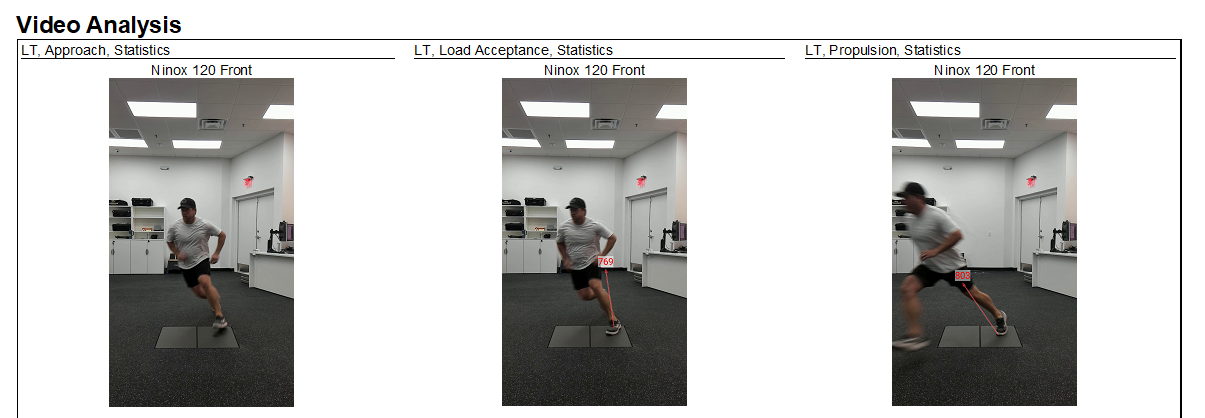
To edit video analysis elements, double-click on the image to modify the definition for the Event.
Jump Parameters
The Jump Parameters table is a default part of any jump analysis report template, including Jump Analysis, Advanced Jump Analysis, and Change of Direction.
To add or remove parameters, double-click on the table in the report and check or uncheck the boxes next to each parameter.
Search for specific parameters by typing the parameter name or by using the Tag filters available in the right column in the Parameters tab.
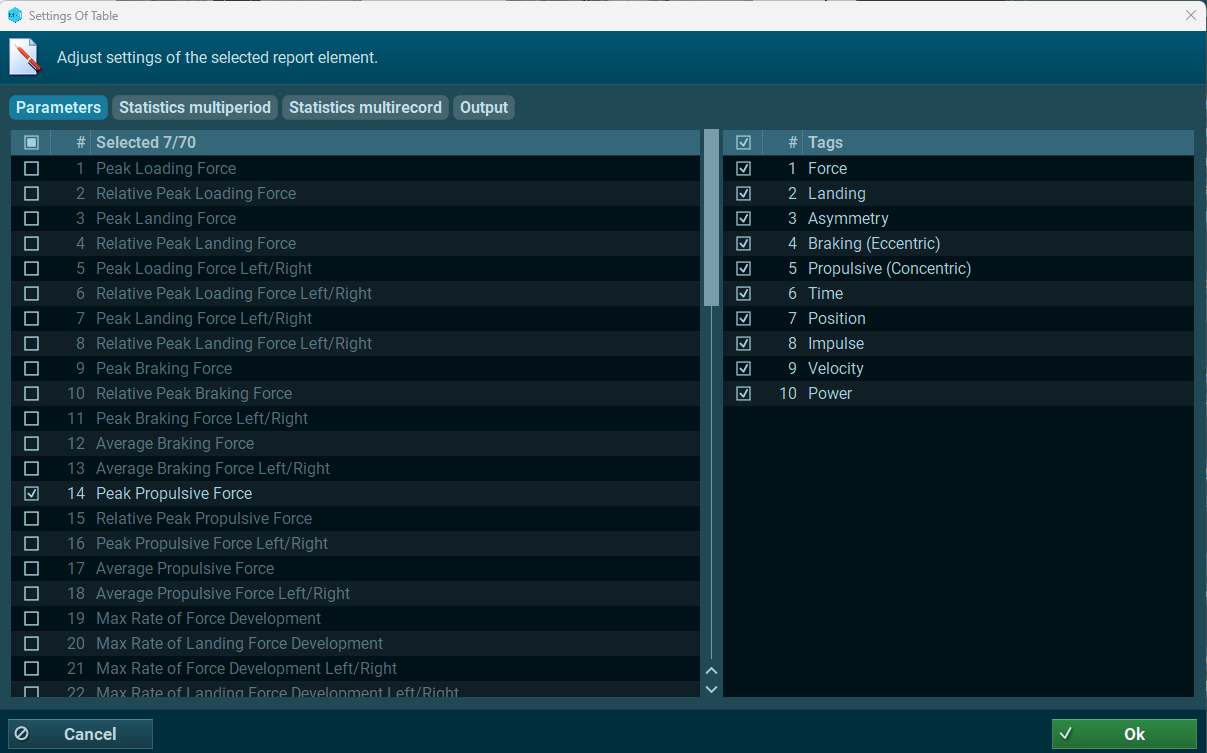
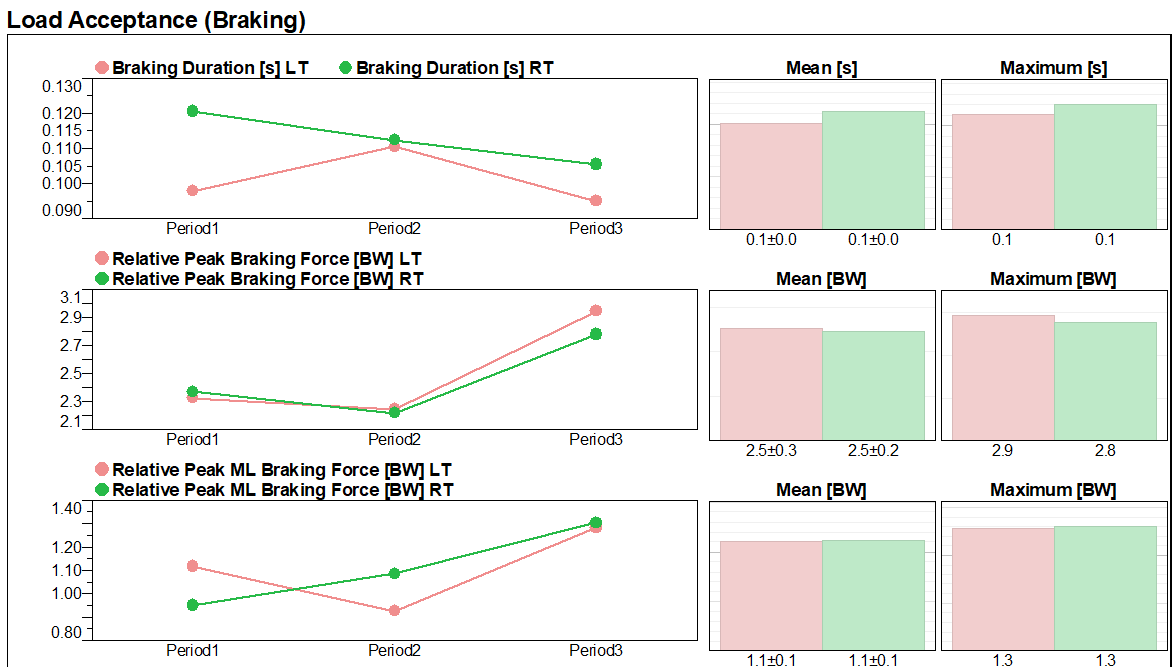
To modify the visual output of the table to a historgram or line graph option to evaluate the progression of the parameters for each jump performed in a recording (period), change the view settings in the Output tab. When a curve or historgram is viewed, right/left or record 1/record 2 comparisons are automatically drawn.
Histogram:
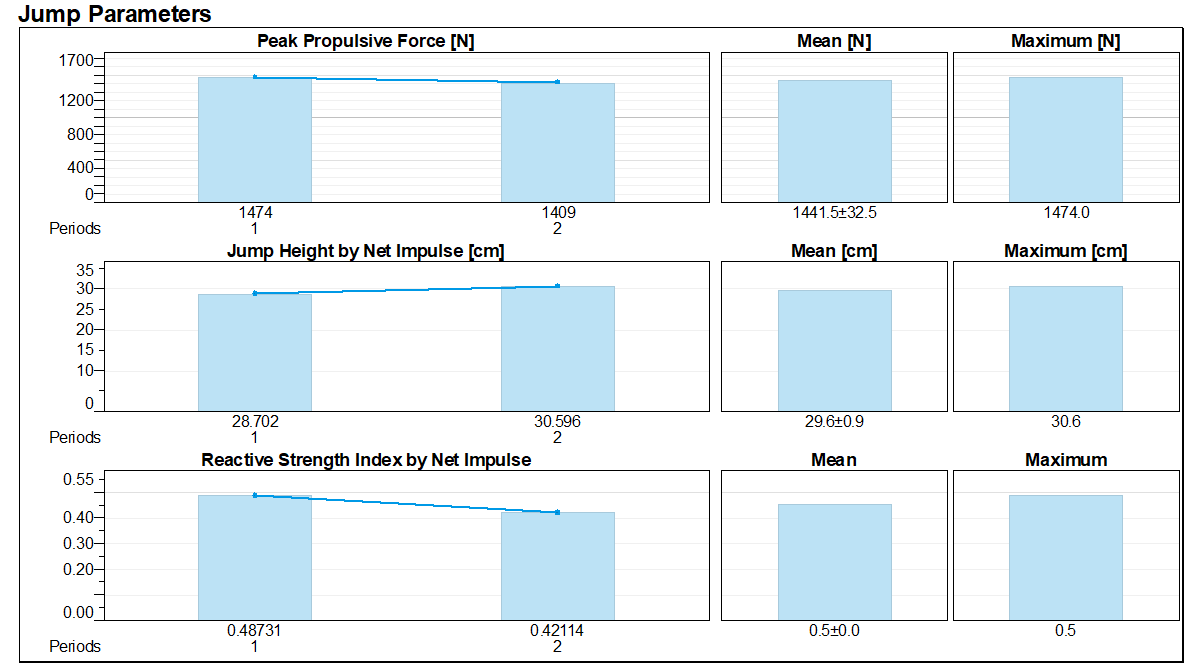
Curve:
Jump Loops
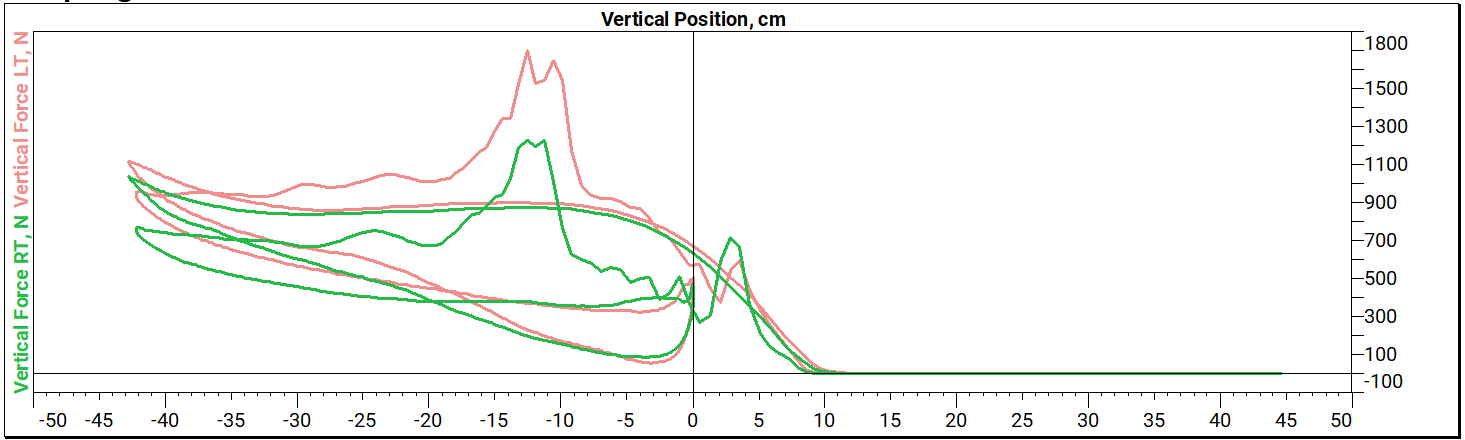
Users can plot selected signals against each other in a parametric or coordination plot to analyze velocity, position, force, or acceleration strategies.
Some examples for using this plot are:
Plotting the COM position vs left/right forces curve to evaluate the positions at which maximum force is produced.
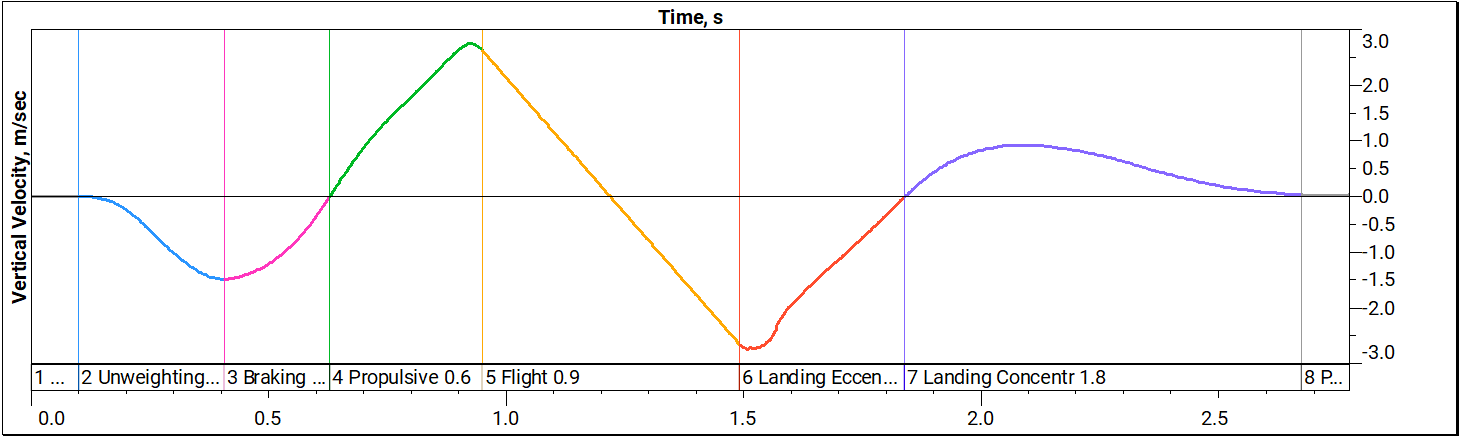
Plotting the vertical velocity vs time to evaluate the velocity of the center of mass velocity during the jump.
Vertical velocity reveals:
- When the athlete transitions from downward to upward motion
- How quickly they reverse direction (a key indicator of stretch-shortening cycle effectiveness)
- Whether the jump is performed efficiently or with excessive braking
This is especially useful for distinguishing explosive vs. strength-dominant movement strategies.
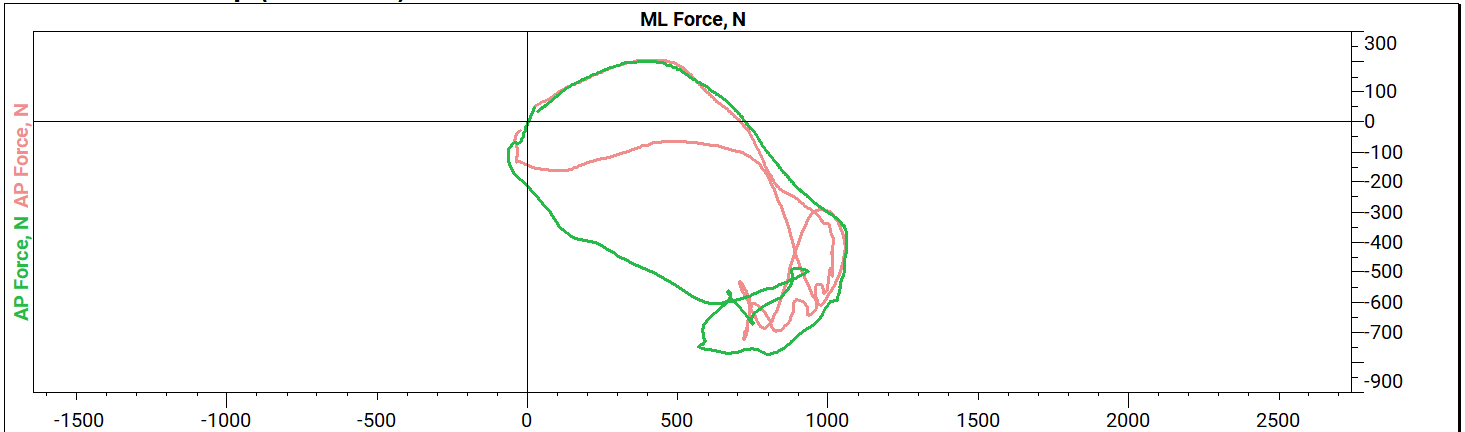
Plotting the ML and AP forces against each other during a cutting activity to evaluate the loading strategy. A wider loop indicates increased lateral loading, while a taller loop reflects greater braking or propulsive effort. The loop’s shape reveals the athlete’s deceleration strategy and ability to redirect momentum.
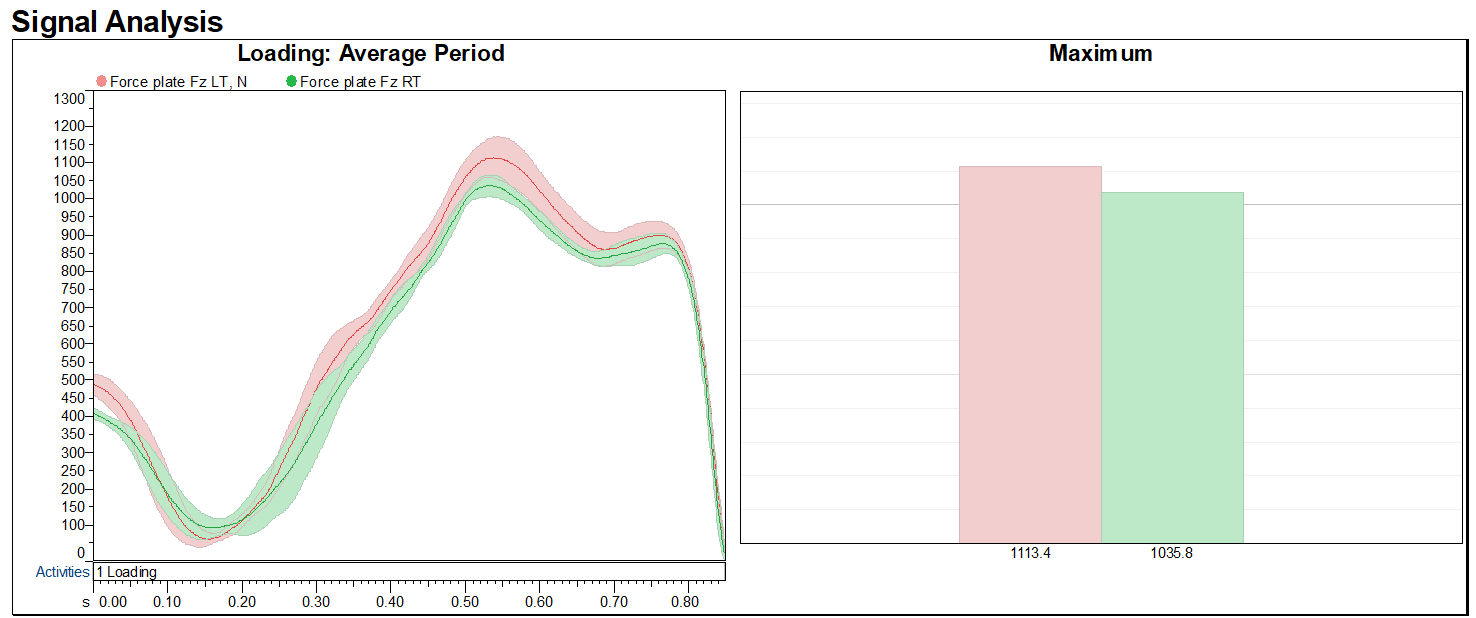
Signal Analysis – Average Curves
Plotting average 3D force and moment curves with mean ± standard deviation allows for visualization of the typical movement pattern across trials while also showing the natural variability in how the athlete produces force and controls moments. This helps identify consistent performance features, detect irregularities, and ensure reliable interpretation of movement mechanics.
For assistance with the creation of specific report elements or modification of existing report templates, reach out to support@noraxon.com.
References
1. Colby SM, Hintermeister RA, Torry MR, Steadman JR. Lower limb stability with ACL impairment. Journal of Orthopedic Sports Physical Therapy. 1999;29:444– 451.
2. Jordan MJ, Aagaard P, Herzog W. Lower limb asymmetry in mechanical muscle function: a comparison between ski racers with and without ACL reconstruction.
Scandinavian Journal of Medicine and Science in Sports. 2015;23(3):e301-309.
3. Maffiuletti NA, Aagaard P, Blazevich AJ, Folland J, Tillin N, Duchateau J. Rate of force development: physiological and methodological considerations. European Journal of Applied Physiology. 2016;116:1091-1116.
4. Simpson JD, Stewart EM, Macias DM, Chander H, Knight AC. Individuals with chronic ankle instability exhibit dynamic postural stability deficits and altered unilateral landing biomechanics: A systematic review. Physical Therapy in Sport. 2019;210-219.
5. Setuain, I, Lecumberri, P, Izquierdo, M. Sprint mechanics return to competition follow-up after hamstring injury on a professional soccer player: A case study with aninertial sensor unit based methodological approach. Journal of Biomechanics. 2017;186-191.