

MR includes a dedicated golf swing analysis workflow using four IMU sensors. The system automatically detects swing events and generates a kinematic sequence report, helping coaches and clinicians evaluate how energy transfers through the body during the swing.
This workflow simplifies setup and delivers clear insights into segment timing, coordination, and posture, enabling more objective feedback for performance training and movement optimization.
Key capabilities
- Automated swing detection
- Kinematic sequence visualization
- Coordinated segment timing & peak velocity analysis
- X-factor & posture angle analysis
- Simplified setup using a 4-sensor configuration
Preparation
Required Noraxon Hardware:
- 4 IMU sensors (placed on the Pelvis, Upper Spine, Upper Arm, and Hand)
- Camera (optional)
Recommended Additional Items:
- Golf club and ball
Setup
Step 1: Place 4 Ultium Motion sensors on the subject on these segments:
- Pelvis
- Upper Spine
- Upper Arm (left for right-handed golfers or right for left-handed golfers)
- Hand (left for right-handed golfers and right for left-handed golfers)
Refer to the 🔗Ultium Motion Getting Started Guide for further details on setting up sensors in the Hardware Setup before proceeding.
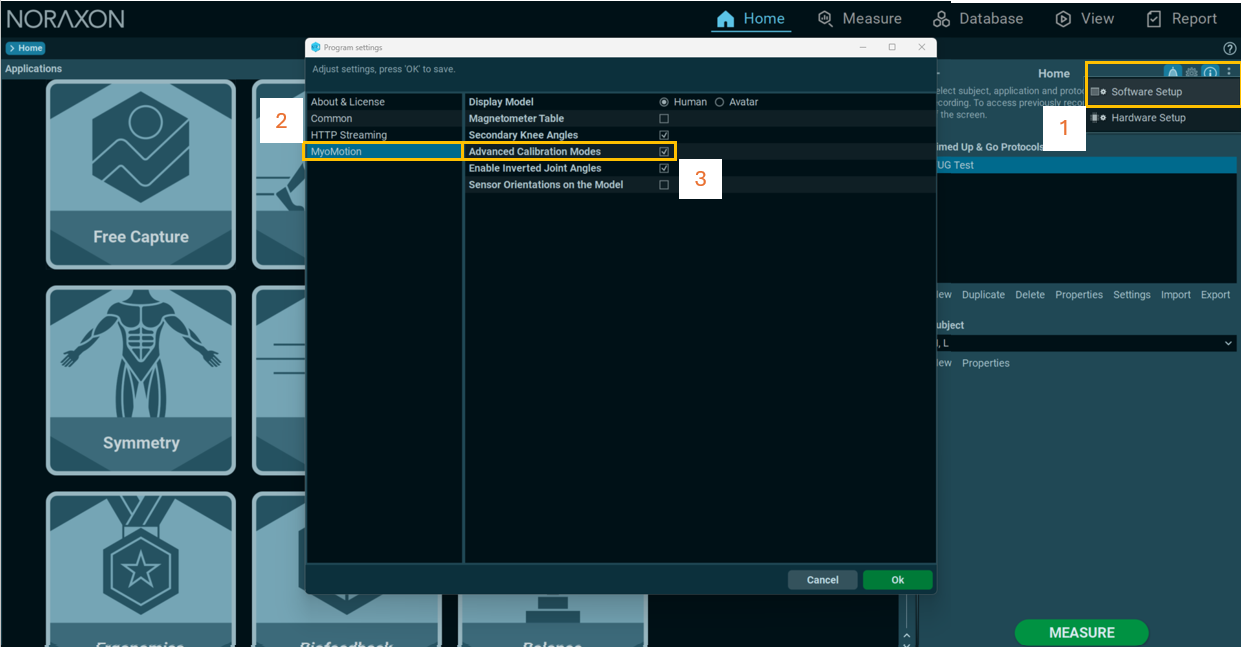
Step 2: Enable Advanced Calibration Modes from the Software Setup to expose the Multipose calibration routine.
Step 3: Create a New Subject or Select one from the list.
Step 4: Select the Kinetic Chain Application and the Golf Swing – RT Handed or Golf Swing – LT Handed Protocol, depending on whether you are working with a left-handed or right-handed golfer.
Note: If desired, click Configuration when the Golf Swing protocol of your choice is selected to confirm the configruation contains the Pelvis, Upper Spine, Left Upper Arm, and Left Hand sensors.
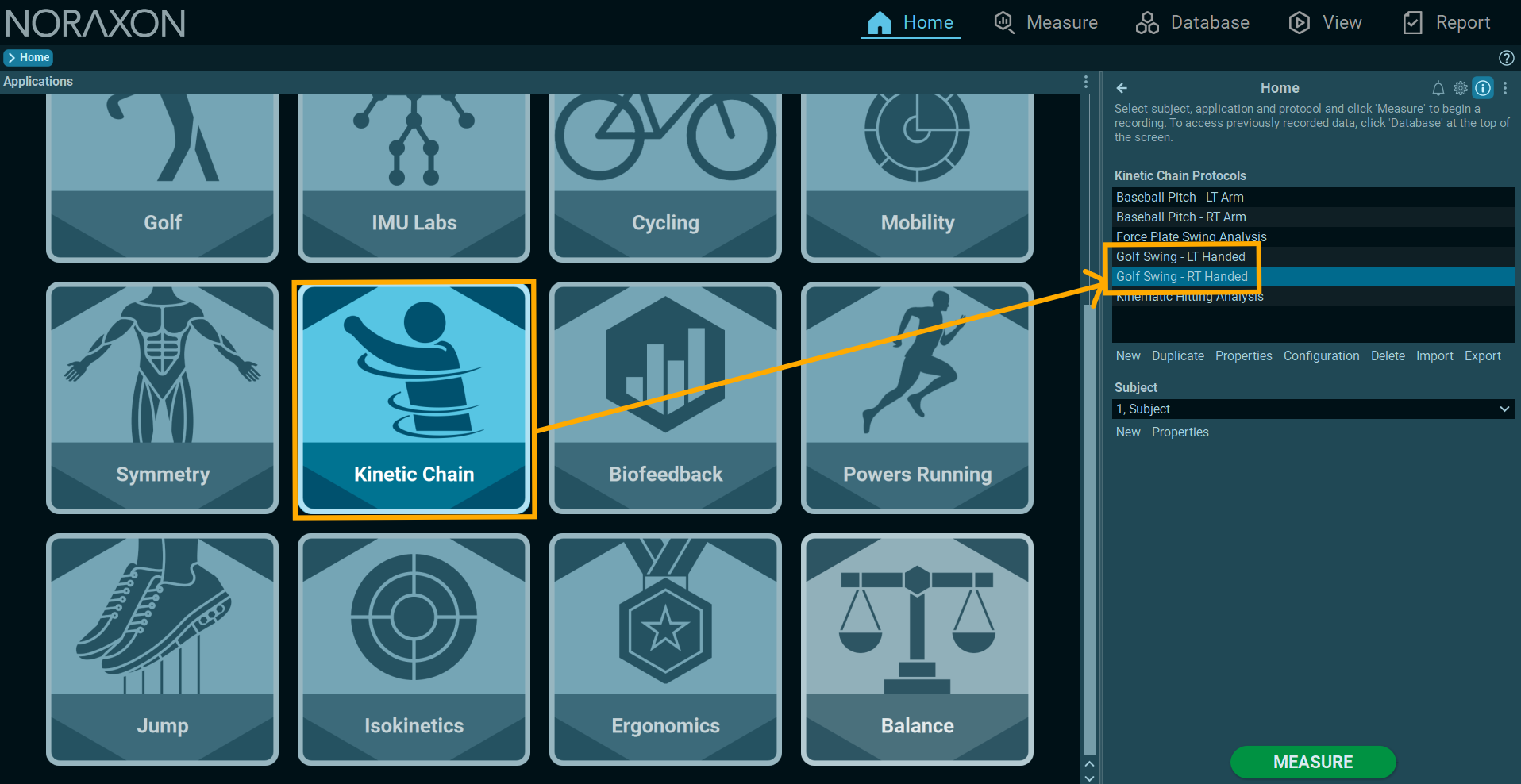
IMPORTANT: If you don’t see the Golf Swing – LT Handed and Golf Swing – RT Handed protocols in the Kinetic Chain application automatically, download them at the link below.
Step 5: Click MEASURE from the HOME screen to start recording

Calibration
Step 1: Select the Multipose Calibration Mode, then click ACTIVATE.
Step 2: Follow the calibration wizard to perform the multipose calibration.
Step 3: After completing the calibration, select Save & Measure Again, then ACTIVATE to apply the calibration to the next recording.
Recording the Golf Swing
When the subject is ready, click RECORD.
Reminders:
- It is recommended to capture a Return to Ref Pose at the beginning of the recording (before performing swings) and the end of the recording (after performing swings).
- For professional golfers who can achieve very high velocities during their swing, it is beneficial to perform Returns to Ref Pose between swings (in addition to the beginning and end) to ensure drift does not spoil the kinematic sequnce plots.
- The subject can perform multiple swings in a single recording.
- Optionally, record Returns to Ref Pose during the measurement for real-time recalibration.
- Ask the subject to pause briefly at the completion of the swing.
Creating the Golf Swing Report
Click REPORT to generate a Golf Swing Analysis. Golf swings are automatically detected in MR with the following phases:
- Backswing
- Downswing
- Follow-though
MR provides the opportunity to add/remove swings or adjust swing detection, if desired.
Once the report is generated, it contains the following elements:
- A kinematic sequence plot displaying the segment timing for the Pelvis, Upper Spine, Upper Arm, and Hand.
- An x-angle plot characterizing the golfer’s x-angle range of motion.
The default report template can be customized to give additional parameters, full-body analysis, or EMG. Reach out to Noraxon Support (support@noraxon.com) for further assistance with desired customizations.
Golf Swing Analysis Interpretation
Kinematic sequencing is a foundational concept in golf swing biomechanics because it describes how energy is generated, transferred, and amplified through the body to the club. In an efficient golf swing, motion follows a proximal-to-distal sequence: the pelvis initiates rotation, followed by the torso, then the lead arm, and finally the club. Each segment reaches its peak angular velocity slightly after the previous one, creating a “whip-like” effect that maximizes clubhead speed at impact. This timing is critical—if segments peak too early, too late, or out of order, energy transfer is disrupted and performance suffers.
From a biomechanical analysis perspective, kinematic sequencing provides a clear, quantifiable way to evaluate coordination rather than just overall speed. Two golfers may produce similar clubhead speeds, but the one with a more efficient sequence typically achieves it with less compensatory motion and lower physical strain.
By examining both the timing (when each segment peaks) and the magnitude (how fast each segment rotates), practitioners can identify specific breakdowns in the swing. For example, an early torso peak relative to the pelvis may indicate poor separation (“X-factor stretch”), while excessive reliance on the arms can suggest a loss of energy transfer from the lower body.
Kinematic Sequence Plot
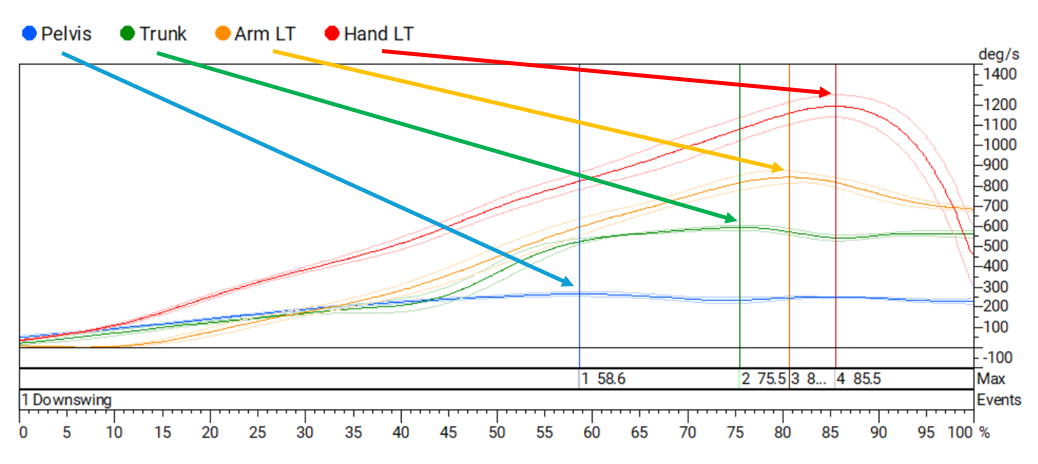
The kinematic sequence plot displays the timing of the peak angular rotation of the Pelvis, Trunk, Arm, and Hand segments. The desired sequence is proximal to distal. Larger, more central segments initiate motion and smaller, distal segments follow in a coordinated cascade
Pelvis → Trunk → Arm → Hand (club)
- The pelvis initiates the downswing, beginning rotation toward the target while the upper body is still completing the backswing. This creates separation and stores elastic energy.
- The trunk accelerates next, reaching its peak angular velocity after the pelvis begins to decelerate. This transfer of energy from pelvis to trunk is critical for generating power.
- The lead arm follows, accelerating as the trunk slows, continuing the energy transfer outward.
- Finally, the hand and club reach peak velocity just before impact, maximizing clubhead speed at the point of contact.
Key Characteristics of an Efficient Sequence
- Sequential acceleration and deceleration: Each segment speeds up, then slows down as energy is passed to the next segment.
- Proper timing gaps: Peaks should not occur simultaneously—there should be a clear delay between each segment’s peak velocity.
- Largest → smallest segments: Energy flows from the body’s core to the extremities, culminating in the club.
This sequence creates a “whip effect”, where energy builds progressively and is released at the club. Deviations—such as the arms firing too early or the pelvis not initiating properly—can reduce clubhead speed, disrupt timing, and increase reliance on compensations.
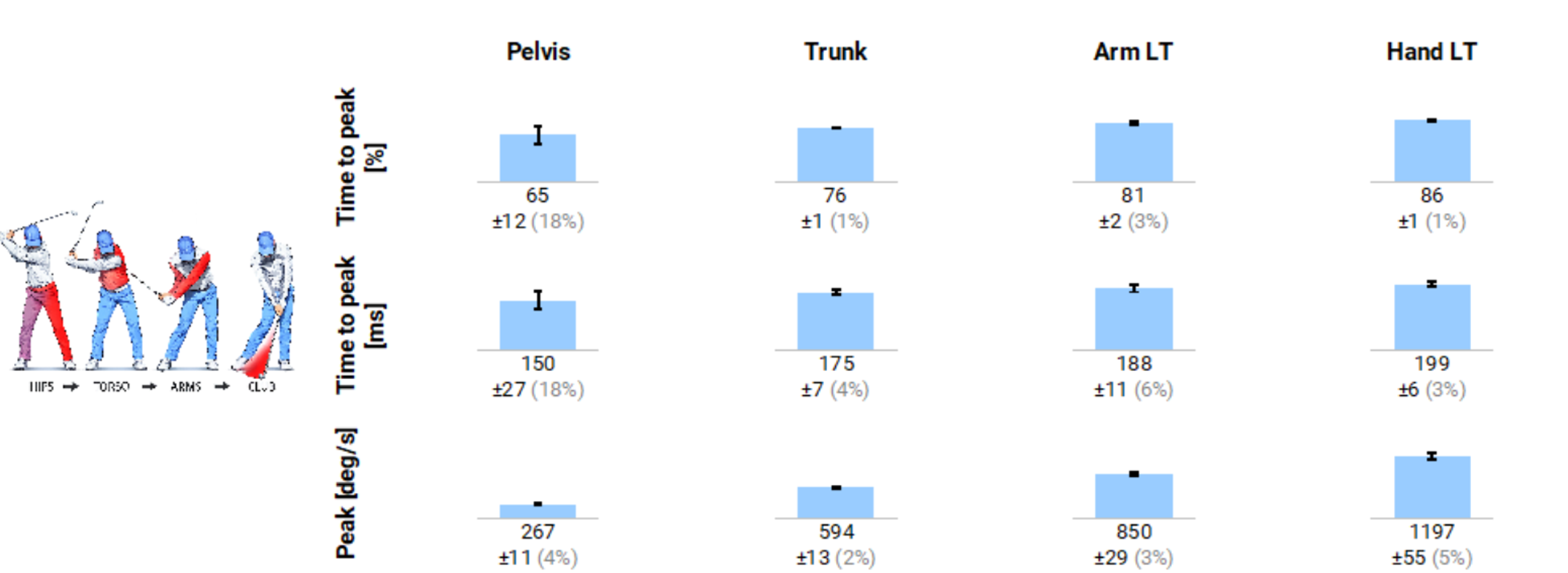
The values show the timing of the peaks and the peak angular velocities. The +/- indicates the standard deviation, if multiple swings were captured in the measurement.
X-Factor Plot
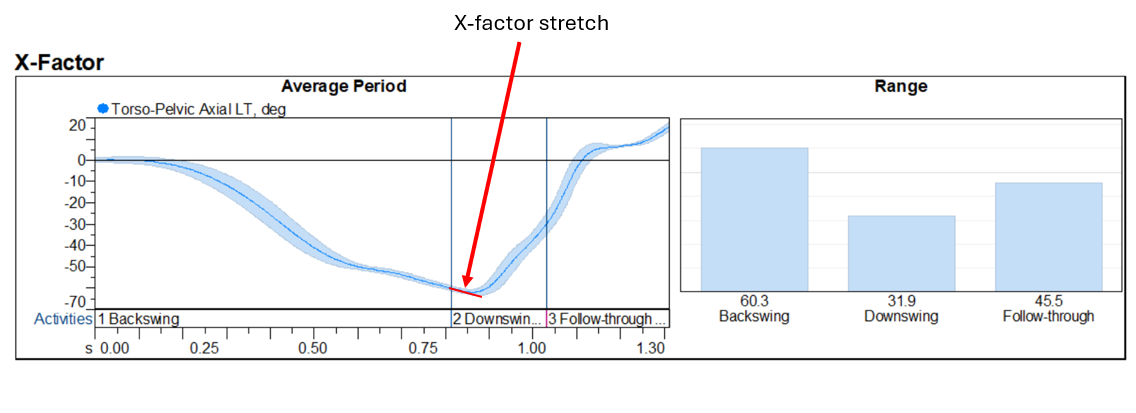
The X-Factor plot represents the rotational separation between the pelvis and trunk (torso) throughout the golf swing, providing a clear visualization of how this relationship evolves from setup through impact. At address and the start of the backswing, the shoulders and hips are relatively aligned, so the separation angle is minimal. As the backswing progresses, the trunk rotates more than the pelvis, causing the separation to steadily increase and reach a maximum near the top of the backswing.
As the golfer transitions into the downswing, an important dynamic occurs. The pelvis begins rotating toward the target before the trunk has completed its motion, causing a brief increase in separation beyond the peak value observed at the top of the backswing. This additional increase is known as X-Factor stretch. On the signal plot, it appears as a small but distinct rise in the separation angle immediately following the backswing peak.
This moment reflects the pelvis leading while the trunk lags, creating a rapid pre-stretch of the musculature around the torso, including the obliques and spinal rotators. Functionally, this behaves like a stretch-shortening cycle, where the stored elastic energy enhances the subsequent rotation of the trunk during the downswing. As a result, the trunk accelerates more effectively after this stretch, supporting efficient energy transfer through the kinematic sequence:
Pelvis → Trunk → Arm → Hand/Club
In a well-coordinated swing, the X-factor plot will show a smooth increase during the backswing, a brief and well-timed peak associated with X-factor stretch early in the downswing, and then a rapid decrease as the trunk rotates through and separation is reduced approaching impact. This pattern is indicative of efficient sequencing and contributes to greater clubhead speed without requiring additional effort.